PDF Download Programming with QT: Writing Portable GUI Applicat: Writing Portable GUI applications on UNIX and Win32, by Matthias Kalle Dalheimer
Programming With QT: Writing Portable GUI Applicat: Writing Portable GUI Applications On UNIX And Win32, By Matthias Kalle Dalheimer. Exactly what are you doing when having extra time? Chatting or searching? Why do not you attempt to review some e-book? Why should be reading? Reviewing is one of fun and enjoyable activity to do in your extra time. By checking out from numerous resources, you could discover brand-new info and also experience. Guides Programming With QT: Writing Portable GUI Applicat: Writing Portable GUI Applications On UNIX And Win32, By Matthias Kalle Dalheimer to read will many starting from clinical e-books to the fiction books. It suggests that you can check out the e-books based on the need that you want to take. Certainly, it will be different and also you can review all publication types any time. As here, we will show you a publication ought to be reviewed. This e-book Programming With QT: Writing Portable GUI Applicat: Writing Portable GUI Applications On UNIX And Win32, By Matthias Kalle Dalheimer is the selection.
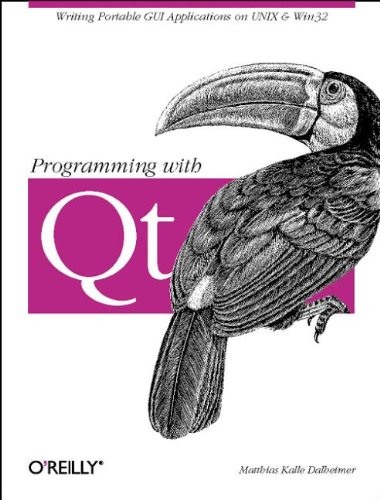
Programming with QT: Writing Portable GUI Applicat: Writing Portable GUI applications on UNIX and Win32, by Matthias Kalle Dalheimer

PDF Download Programming with QT: Writing Portable GUI Applicat: Writing Portable GUI applications on UNIX and Win32, by Matthias Kalle Dalheimer
Superb Programming With QT: Writing Portable GUI Applicat: Writing Portable GUI Applications On UNIX And Win32, By Matthias Kalle Dalheimer book is always being the most effective good friend for spending little time in your workplace, evening time, bus, and everywhere. It will certainly be an excellent way to simply look, open, and read the book Programming With QT: Writing Portable GUI Applicat: Writing Portable GUI Applications On UNIX And Win32, By Matthias Kalle Dalheimer while in that time. As understood, encounter as well as ability don't always come with the much money to obtain them. Reading this book with the title Programming With QT: Writing Portable GUI Applicat: Writing Portable GUI Applications On UNIX And Win32, By Matthias Kalle Dalheimer will let you recognize much more points.
As known, many individuals claim that books are the custom windows for the globe. It doesn't mean that getting book Programming With QT: Writing Portable GUI Applicat: Writing Portable GUI Applications On UNIX And Win32, By Matthias Kalle Dalheimer will certainly suggest that you could purchase this globe. Just for joke! Checking out an e-book Programming With QT: Writing Portable GUI Applicat: Writing Portable GUI Applications On UNIX And Win32, By Matthias Kalle Dalheimer will certainly opened up a person to assume much better, to maintain smile, to entertain themselves, as well as to encourage the expertise. Every book also has their unique to influence the viewers. Have you known why you read this Programming With QT: Writing Portable GUI Applicat: Writing Portable GUI Applications On UNIX And Win32, By Matthias Kalle Dalheimer for?
Well, still perplexed of the best ways to obtain this publication Programming With QT: Writing Portable GUI Applicat: Writing Portable GUI Applications On UNIX And Win32, By Matthias Kalle Dalheimer here without going outside? Simply link your computer or kitchen appliance to the website and start downloading and install Programming With QT: Writing Portable GUI Applicat: Writing Portable GUI Applications On UNIX And Win32, By Matthias Kalle Dalheimer Where? This page will show you the link web page to download and install Programming With QT: Writing Portable GUI Applicat: Writing Portable GUI Applications On UNIX And Win32, By Matthias Kalle Dalheimer You never ever fret, your favourite book will be quicker yours now. It will be a lot easier to appreciate checking out Programming With QT: Writing Portable GUI Applicat: Writing Portable GUI Applications On UNIX And Win32, By Matthias Kalle Dalheimer by on the internet or obtaining the soft data on your gadget. It will despite which you are and also just what you are. This publication Programming With QT: Writing Portable GUI Applicat: Writing Portable GUI Applications On UNIX And Win32, By Matthias Kalle Dalheimer is composed for public and also you are among them which could enjoy reading of this e-book Programming With QT: Writing Portable GUI Applicat: Writing Portable GUI Applications On UNIX And Win32, By Matthias Kalle Dalheimer
Investing the spare time by checking out Programming With QT: Writing Portable GUI Applicat: Writing Portable GUI Applications On UNIX And Win32, By Matthias Kalle Dalheimer could supply such wonderful experience also you are only seating on your chair in the office or in your bed. It will not curse your time. This Programming With QT: Writing Portable GUI Applicat: Writing Portable GUI Applications On UNIX And Win32, By Matthias Kalle Dalheimer will certainly assist you to have even more valuable time while taking rest. It is quite enjoyable when at the midday, with a mug of coffee or tea and also a book Programming With QT: Writing Portable GUI Applicat: Writing Portable GUI Applications On UNIX And Win32, By Matthias Kalle Dalheimer in your device or computer monitor. By delighting in the views around, here you can start reading.
Qt is a C++ class library for writing GUI applications that run on UNIX, Windows 95/98, and Windows NT platforms. Qt is much easier to use than the standard Motif toolkit for UNIX systems, but at the same time Qt emulates the look-and-feel of Motif. Best of all, after you have written an application with Qt, all you have to do is recompile it to have a version that works on Windows systems. Qt also emulates the look-and-feel of Windows, so you can provide all of your users with native-looking interfaces.Platform independence is not the only benefit of Qt. Qt uses an ingenious signal/slot mechanism for connecting user interaction with program functionality, providing an excellent framework for component-based programming. Graphical rendering in Qt is highly optimized due to its use of effective caching mechanisms -- rendering in Qt is often faster than with the similar native API. In addition to user interface classes, Qt features portable support for file system access, working with date and time values, and network programming. With Qt, you'll find that you need to write very little, if any, platform-dependent code because Qt already has what you need.Qt is popular with open-source and Linux developers because it can be used for free on UNIX systems for this type of development. For commercial development, you need a license for Qt, which is available from Troll Tech, the developers of Qt. In addition to open-source development, Qt is being used by several major companies and government and international agencies.While programming with Qt is straightforward and feels natural once you get the hang of it, the learning curve can be steep. Qt comes with excellent reference documentation, but beginners often find the included tutorial is not enough to really get started with Qt. That is where this book steps in. Programming with Qt guides you through the steps of writing a Qt application by showing you how to write a simple paint application. It also helps deepen your understanding of the topics with exercises and fully worked out answers. The book presents all of the GUI elements in Qt, along with advice about when and how to use them, so that you can make full use of the toolkit. There's also lots of information for seasoned Qt programmers, including material on advanced 2D transformations, drag-and-drop, and writing custom image file filters.Programming with Qt helps you get the most out of Qt. With it, you'll learn to take full advantage of this powerful, easy-to-use, cross-platform toolkit.
- Sales Rank: #3877204 in Books
- Brand: Brand: O'Reilly Media
- Published on: 1999-04-11
- Original language: English
- Number of items: 1
- Dimensions: 9.19" h x .83" w x 7.00" l,
- Binding: Paperback
- 380 pages
Features
- Used Book in Good Condition
Amazon.com Review
Programming with Qt offers an excellent introduction to the Qt toolkit, a powerful C++ graphical user interface (GUI) library that allows developers to create interfaces that run under both Unix and Windows. The book first looks at the strengths of the Qt library: it provides excellent cross-platform support, good performance, and ease of use for the C++ programmer.
After a basic application, the book moves onto the event model in Qt, which uses signals and slots to attach events to code. The author demonstrates that Qt is a remarkably sophisticated user interface library. Early sections examine programming menus, including pop-up menus, basic widgets, or controls (such as labels and listboxes), and more complex controls (such as sliders, progress bars, listviews, and tables).
Next the book presents material on Qt's built-in dialogs (for message boxes and opening and saving files) and layout managers. The author investigates Qt's container classes (such as arrays and dictionaries) and offers a lot of material on 2-D graphics, including printing, saving, and loading images.
Later chapters look at validating text and working with files and directories, with tips on important topics such as focus handling, internationalization, portability, and debugging. (The author even shows you how to work with Qt in Perl and reviews several Qt GUI builders that help automate design.)
Filled with expert advice and sample code, this guide makes a strong case that both Unix and Windows developers should try out Qt. --Richard Dragan
Review
Read the full review for this book.
One area the author focuses on throughout the book, and to good effect, is Qt's use of signals and slots. (These are not traditional UNIX IPC signals, but a variation unique to Qt.) This is the technology that notifies specific parts of a program when UI events happen, such as users clicking on a button or an item in a listbox. Every application framework has its own way of performing this "plumbing," and understanding it well enough to get notifications in the right places, forward them effectively, and so on, is critical to using the framework. Dalheimer clearly appreciates this fact, and doesn't just talk about Qt's signals and slots once and then move on, but returns to the topic several times in different contexts. --Lou Grinzo, Dr. Dobb's Electronic Review of Computer Books -- Dr. Dobb's Electronic Review of Computer Books
About the Author
Matthias Kalle Dalheimer is the President & CEO of Klaralvdalens Datakonsult AB, a Sweden-based consultancy specializing in platform-independent software solutions. He is also a founding member of the KDE project and the current president of the KDE foundation. Kalle has written numerous books for O'Reilly, both in English and in his native German, including "Running Linux" and "Programming with Qt". In his spare time, he enjoys cross-country skiing and reading history books. Kalle lives with his wife Tanja and his two sons Jan and Tim in the middle of the forest near Hagfors in the Swedish province of Varmland.
Most helpful customer reviews
4 of 4 people found the following review helpful.
Woefully out of date.
By D. Kelley
Unless you are seeking a historical perspective back to rev 3 I would suggest you skip this one. As it was written for Qt3, circa 2002 it has very little that could be called current in today's world of 4.7 and beyond. At the time I wrote this 4.8 has been released, and Nokia (the current Qt owner) has chosen a different path for its own future. The Licensing model used then was different, and the concept of Microsoft dot.Net did not exist in the Windows world so cross-porting there was in fact simpler by today's environment. The book itself is well written, but time has passed it by.
9 of 9 people found the following review helpful.
Good, if outdated, introduction to Qt
By Andrew Fairley
Book starts out strong, and was helpful as an introduction for Qt. However, it seems to cut out about 350 pages in, putting subjects such as "Focus Handling" in its own 3 page chapter, rather than integrating it into an existing chapter. That said, the Portability chapter, which includes a list of Qt functions that are not portable, was a valuable addition.
Keep in mind, the 2nd edition of Programming for Qt was written for Qt 3. At the time of this review, the latest version of Qt is version 4. This is a problem because Trolltech appears to reinvent the wheel for each major version. While the author had me salivating at the thought of a QStyleSheet, checking the API docs for Qt 4 QStyleSheet is now a deprecated class, and as far as I can tell there is no current equivalent.
One aspect I wish the author had covered in more detail is the actual compiling and linking of applications that use Qt. I'm starting to get the impression that Trolltech's dirty little secret is that while their API is both clean and thorough, the signal/slot method is overly reliant on #defines, and the developer has to compile and link as many as twice the number of files to make it function. Trolltech includes a program 'qmake' almost as a bandaid which will generate Makefiles that will then automatically generate and compile the extra 'moc' files. The problem is that if you're porting an application to Qt, you're likely to have existing makefiles. Adding the additional layer of qmake and it's .pro files is both cumbersome and not actually necessary. While you can certainly figure out on your own how to avoid using qmake, it would have been helpful if the book described the functionality of the qmake-generated makefiles. This would help developers porting to Qt to include that functionality in their existing makefiles.
2 of 2 people found the following review helpful.
Needs more depth
By W. Taylor
I found this book to be clearly written, and not difficult to follow and succinct, and not sufficient to answer enough of my programming questions to feel comfortable creating my own programs. You definitely need to study the Troll Tech-provided documentation to go very far beyond the book in programming, but the documentation reads like it was written as a reference, for people who understand but simply need a reminder. The book needs about two hundred more pages explaining examples and critical subjects like slot-signal interactions, layouts and many of the widgets more completely.
This book makes a good overview, but needs more depth. At the time, it was about the only book available, so I cannot say that it was a mistake to get the book when I did. I hope that other books coming out on Qt have more depth and more complete explanations.
See all 29 customer reviews...
Programming with QT: Writing Portable GUI Applicat: Writing Portable GUI applications on UNIX and Win32, by Matthias Kalle Dalheimer PDF
Programming with QT: Writing Portable GUI Applicat: Writing Portable GUI applications on UNIX and Win32, by Matthias Kalle Dalheimer EPub
Programming with QT: Writing Portable GUI Applicat: Writing Portable GUI applications on UNIX and Win32, by Matthias Kalle Dalheimer Doc
Programming with QT: Writing Portable GUI Applicat: Writing Portable GUI applications on UNIX and Win32, by Matthias Kalle Dalheimer iBooks
Programming with QT: Writing Portable GUI Applicat: Writing Portable GUI applications on UNIX and Win32, by Matthias Kalle Dalheimer rtf
Programming with QT: Writing Portable GUI Applicat: Writing Portable GUI applications on UNIX and Win32, by Matthias Kalle Dalheimer Mobipocket
Programming with QT: Writing Portable GUI Applicat: Writing Portable GUI applications on UNIX and Win32, by Matthias Kalle Dalheimer Kindle
Programming with QT: Writing Portable GUI Applicat: Writing Portable GUI applications on UNIX and Win32, by Matthias Kalle Dalheimer PDF
Programming with QT: Writing Portable GUI Applicat: Writing Portable GUI applications on UNIX and Win32, by Matthias Kalle Dalheimer PDF
Programming with QT: Writing Portable GUI Applicat: Writing Portable GUI applications on UNIX and Win32, by Matthias Kalle Dalheimer PDF
Programming with QT: Writing Portable GUI Applicat: Writing Portable GUI applications on UNIX and Win32, by Matthias Kalle Dalheimer PDF


![[ [ [ Noches de Baile en el Infierno = Prom Nights from Hell (Narrativa (Punto de Lectura)) (Spanish) [ NOCHES DE BAILE EN EL INFIERNO = PR](https://lh3.googleusercontent.com/blogger_img_proxy/AEn0k_uizYmSiXU0P6dppviZ0Ee99UD4_LiHlS5HfqyYFjnVNmaut72ZbISBbCki-CPUEVdBdNFgOhJ0QSQg1xLkyqNWyEbwB4qTYU5W6cvTMn7vSS__3pTWBU8=s0-d "[ [ [ Noches de Baile en el Infierno = Prom Nights from Hell (Narrativa (Punto de Lectura)) (Spanish) [ NOCHES DE BAILE EN EL INFIERNO = PR")


